Monday, May 21, 2012

Bavaria


For the 4-day Ascension holiday weekend, Emilie and I decided to do a road trip through the Bavaria region of southern Germany.

Our first stop was Füssen, a small town near the Austrian border that began as a settlement during Roman times. And while Füssen is no doubt a very nice town in its own right, we had actually chosen it due to its proximity to a specific sight that would serve as our first visit of the trip: the Neuschwanstein castle.

The castle was commissioned by King Ludwig II of Bavaria during the 19th century and was to serve as both a personal retreat and a form of homage to the composer Richard Wagner. Also of note, it later served as the inspiration for Disneyland's Sleeping Beauty castle.


Our visit included a castle tour that touched upon the life of Ludwig II, the history of the castle itself, as well as the stories behind the many rooms that we passed through. It was very interesting (particularly the mysterious circumstances surrounding Ludwig's death), though I'd have to say that my favorite part of the visit ultimately turned out to be the castle's surroundings. As evidenced by the picture below, the views that the castle's location afforded were absolutely stunning.


After finishing up our visit at Neuschwanstein, we decided to take a bit of a detour on the way to our next stop and drove across the border to Austria. The drive provided beautiful alpine views and we were surprised to see a lot of snow even at relatively low elevations. Apparently it had been very cold in recent days with a fair amount of new snow.


As we returned to Germany we passed through the resort town of Garmisch-Partenkirchen, site of the 1936 Winter Olymplics. Shortly thereafter we arrived in Ettal, which is known for its Benedictine monastery that dates back to the middle ages. The current monastery, pictured below, was constructed during the mid-18th century.


Next we headed to another of King Ludwig II's Bavarian retreats -- Linderhof Palace. It was inspired by Versailles (Louis XIV was an idol for Ludwig), with many of its features based on the French palace (albeit on a much smaller scale).


Like Neuschwanstein castle, Linderhof is surrounded by beautiful scenery. Ludwig apparently chose the location due to his fond memories of hunting with his father in the area during his youth.


After Linderhof, we stopped in a small town called Oberammergau to walk around for a bit. The town is known in part for its lüftlmalerei -- frescoes on the walls of buildings and homes that depict traditional Bavarian culture, religious themes and fairy tales. If you look closely at the picture below, you can see some examples on the building.


For our final stop of the day, we visited the Pilgrimage Church of Wies. It was built in the mid-18th century to house a wooden figure of Christ on which real tears were seen in 1738 and ultimately deemed a miracle (hence the attraction for religious pilgrims).


The most impressive part of the church was definitely its interior, with detailed frescoes and sculptures. The picture below probably doesn't do the church justice, but at least it offers a glimpse of what we saw inside.

Monday, May 7, 2012

The Flan is in the Oven


Yesterday was the final round of the French presidential election. As expected, François Hollande defeated the incumbent, Nicolas Sarkozy, becoming the first Socialist president since Mitterand in the 80s. The general feeling isn't so much that there was massive support for Hollande, but instead that people were simply sick of Sarkozy and in need of a change.

The announcement of the (forecasted) results was pretty comical, as in France it is illegal for media outlets (TV, radio, print, internet, etc.) to release the results before all polling stations have closed at 8pm. As such, the French media are forced to play a game of pretending not to know who the projected winner was, despite the fact the results had been leaked via foreign news outlets, twitter messages, blog posts, etc. hours earlier.

It was particularly funny whenever the TV news programs cut to live shots of the two candidates respective supporters. The commentators basically had to pretend not to know the results even though the moods conveyed by the crowds were dead giveaways as to who had won (e.g., ecstatic Hollande supporters; subdued Sarkozy supporters).

And perhaps the biggest joke of the night was the forced drama around the 8pm countdown to the results announcement, which relied on the manufactured suspense of a bad reality TV program (imagine dramatic music and countdown graphics). How the commentators kept straight faces throughout the broadcast is beyond me, though the €75,000 fine for leaking the results surely played a role.

The best part of the legal anachronism surrounding "premature annunciation" was definitely the length to which average French citizens would go to hint at the results without breaking the spirit of the law (most notably via coded blog posts and twitter messages). Here's the link to an article that I found describing this phenomenon with respect to the first round of the election.

Sunday, May 6, 2012

Day Trips


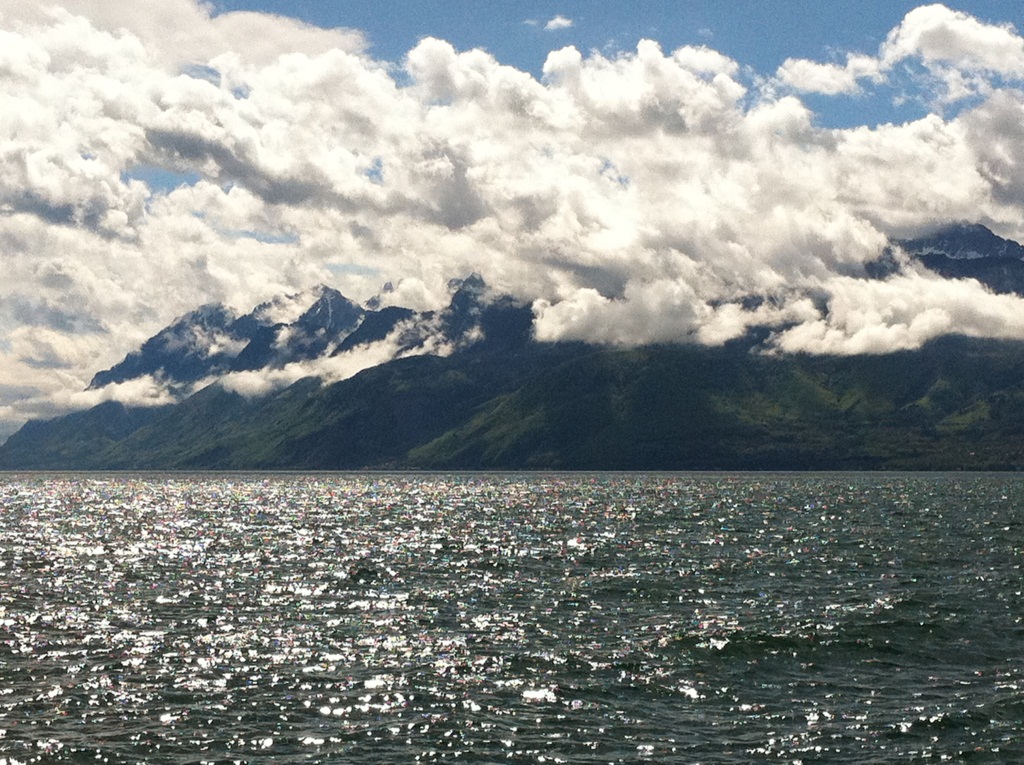
This weekend consisted of a couple of day trips to France. On Saturday, we headed across the lake to Evian for lunch with Emilie's sister and her fiancé. It was supposed to rain most of the day, but the sun decided to stick around all afternoon. Here are a couple of photos that I took during the boat ride to Evian.


On Sunday, we headed to Emilie's mom's place in the Jura so Emilie could vote in the deuxième tour (second round) of the French presidential election. More importantly, this allowed us to have a nice lunch compliments of Emilie's mom. Here's a photo looking at back at Lake Geneva during the drive.

Friday, May 4, 2012

Munchen

 
This week I was in Germany for work, spending some time in both Munich and a small town about an hour south called Murnau that is near the Austrian border. It was my first "real" visit to Munich, as every other time I've been to the city simply entailed changing planes at the Munich airport.

In reality, my first "real" visit didn't provide much of an opportunity to see the city beyond passing a couple of landmarks while in a cab. Fortunately, though, Emilie are going back to Munich in a few weeks so I'll finally be able to tour the city property.

Murnau was very nice and had a real alpine feel to it. I never knew that Munich was only a short drive from the mountains. Here's a photo that I took from the hotel.


Given the limited free time, the only other area of interest to report on was the food and drink. There was some very good wurst and, of course, some great Bavarian beers. And everything seemed to be served with spargel -- asparagus. Apparently it's currently in season.

Thursday, April 26, 2012

French Election


Sunday was the premier tour (first round) of France's presidential election. To get on the ballot one needs to get signatures from 500 elected officials (e.g., mayors, representatives, etc.), and this year 10 candidates qualified.

The results of the first round were as follows:

 - François Holland (Socialist, center-left): 29%
 - Nikolas Sarkozy (UMP, center-right): 27%
 - Marine Le Pen (National Front, far-right): 18%
 - Jean-Luc Mélenchon (Left Front, far-left): 11%
 - François Bayrou (Democratic Movement, center): 9%
 - Other: 6%

Note: The use of "left" and "right" above is based on the classification used by the French. I'm not sure exactly where Democrats and Republicans would fit on the above spectrum, though it's safe to say that, on average, the "center" in France would skew a bit more towards the "left" in the U.S.

As none of the candidates received a 50% majority, the top two candidates -- in this case Holland and the incumbent Sarkozy -- will compete in the deuxième tour (second round) a week from this Sunday. The winner in that vote will be president.


It's worth highlighting that voter turnout was 80%, which is apparently typical for French presidential elections. This puts the U.S. to shame as turnout for the 2008 presidential election in the U.S. was only around 62%.

Wednesday, April 25, 2012

Luck of the Irish?

 
I've done plenty of stupid things in my life, and on Sunday night I added another one to the list. In what can only be described as sheer idiocy on my part, I managed to leave my camera on the train from Paris to Lausanne.

I have no idea how it happened. In fact, I remember doing a double-check as we were leaving and was sure that we had everything. And the best part -- I didn't even notice until the next morning. In what was effectively a moment of clarity, the painful realization set in out of nowhere and was immediately confirmed after a quick search of the apartment.

After a quick assessment of the situation, I ascribed the odds of ever seeing my camera again at around 0%. Had I realized on Sunday night and called the train company immediately, perhaps there would have been a chance. But given the circumstances, I more or less accepted the likely outcome.

Based on feedback from friends and colleagues, my fears were more or less supported. A cynical view of the average human being's moral compass was pretty much par for the course, with one of Emilie's colleagues even admitting that she probably would have kept it (who says that by the way?).

There was one person who held out hope, however -- my dad. His argument was that 95% of people in this world are trustworthy and do the right thing. As long as one of the 5%-ers didn't come across my camera first, I should be in good shape.

***

On Monday morning I filed a claim online with the train company and called the Lost & Found offices at the train stations in both Paris and Lausanne. Then it simply became a waiting game. If the camera was found, I would be notified. If not, no response would be provided.

The one positive was that aside from the photos taken in Paris, I had already backed up the photos from my previous trips. Nonetheless, given the amount of money that I had invested in the camera, and the fact that it was less than three years old, such a positive provided little comfort.

And to add insult to injury, I found an email exchange with my insurance company from a couple years back where I had inquired about supplemental coverage in the event of loss/theft outside of the home. Needless to say, I had ultimately decided that insurance wasn't necessary / worth it. Big mistake.

***

With each day that passed...Monday...Tuesday...I saw the odds of getting my camera back decreasing exponentially. And given that I had calculated the initial likelihood of getting it back at around 0%, I guess that means that as time went by I almost expected to be contacted by the thief himself specifically asking for me to send him the 2nd lense, the battery charger and the user guides / software (which I hadn't taken with me to Paris).

Thus, I have to admit that I was absolutely shocked when I received a form email late Tuesday from the train company indicating that they had found the camera. All I needed to do was come to the office at the Lausanne train station this morning and I could pick it up.

Apparently one of the train employees had noticed the camera while doing a standard search of the train and logged it in as a missing item immediately. The two-day delay was simply due to procedural issues as it had to be processed in a central Lost & Found office in Bern.

***

Talk about lucky, huh? I guess my dad was right and there really are some good people out there. That said, I think I'll go ahead and sign up for the insurance that I passed on before. No need to take any chances in case I'm dependent on someone like Emilie's morally deficient colleague next time...

Monday, April 23, 2012

Paris (cont.)

.
We spent Sunday taking in Paris' cultural side by visiting a number of museums. Our first stop was the Jeu de Paume, a contemporary art museum that currently has an exhibition by China's Ai Weiwei.

I thought that Mr. Ai's works were very interesting -- he's clearly both an artist and political activist. One of my favorite pieces (pictured below) is titled Dropping a Han Dynasty Urn.


Shortly before leaving the exhibit, we passed a window that offered a nice view of the Eiffel Tower as well as the obelisk in the Place de la Concord.


Next we visited the Musée de l'Orangerie, a gallery of impressionist and post-impressionist paintings that is home to eight Nymphéas (Water Lilies) murals by Claude Monet. The murals are massive, with four each in two separate rooms. You're effectively surrounded by Monet's interpretations of his garden in Giverny. Here's a photo I found online shows a portion of one of the rooms.


While Monet's water lilies murals were definitely the highlight of the visit, there were also plenty of other interesting paintings by artists such as Cézanne, Matisse, Picasso and Renoir.

We finished our cultural tour with a visit to the Musée Rodin -- by far the most scenic of the three museums that we visited. It's basically a 18th century estate that has a number of Rodin's works in the house itself and throughout the massive garden. Here's a photo that I took from the garden.


I can't say that I'm very knowledgeable with respect to Rodin's work, though the one pictured below obviously rang a bell -- Le Penseur (The Thinker).


After finishing up at the Rodin museum, it was time to go back to the hotel to pick up our bags and then head to the train station. On the way we passed by the Presidential palace, which can't be a very happy place these days given Sarkozy's current spot in the polls. He's projected to come in 2nd in the first round of the presidential election today, which gets him to the second (and final) round but doesn't bode well for his ultimate chances for reelection.

Paris

.
This weekend we headed to Paris, taking the Friday afternoon train from Lausanne after work. The trip served two purposes: a birthday visit for me and an opportunity for Emilie to buy a dress, shoes, etc. for her sister's upcoming wedding.

Saturday morning was Emilie's designated shopping time, so I took the opportunity to sightsee a bit and explore the area around our hotel in the 8th arrondisement. My first stop was the Église de la Madeleine, a 19th century church that has the look of a Roman temple.


From the steps of the church, there was a nice view in the direction of my next stop -- the Place de la Concord .


At the center of the plaza is a 75 foot tall Egyptian obelisk that was once found at the entrance of the Luxor Temple. The obelisk is definitely better than the guillotine that stood in its place during the French Revolution. In fact, many notable figures met there fate in the plaza, including Louis XVI, Mary Antoinette and Robespierre.


Adjacent to the plaza is the Tuileries Garden. Given that it was a bit cool and windy out, I limited my visit to a quick photo.


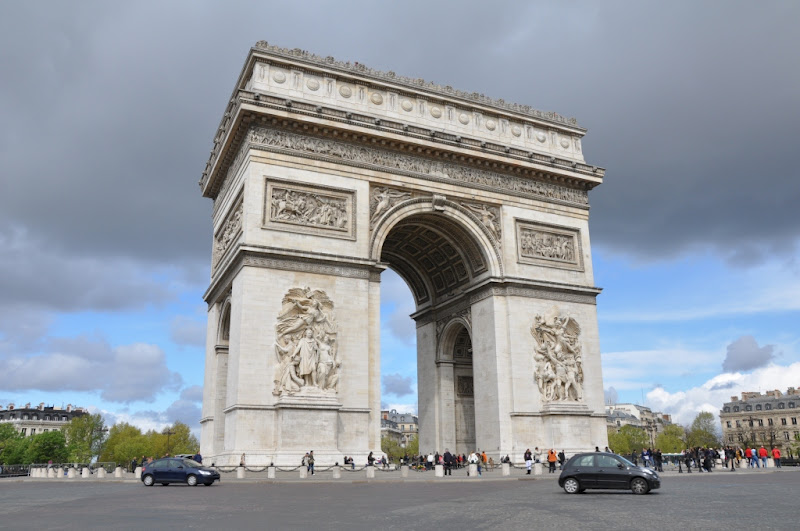
At this point I still had an hour to spare before Emilie and I were supposed to meet up for lunch, so I decided walk along the Champs-Élysées from the Place de a Concord to the Arc de Triomphe. Here's the view as I started out.


When I arrived at the Arc de Triomphe, I saw some tourists who apparently didn't know that there's a pedestrian tunnel that is used to access the monument at the center of the roundabout. Instead, they were trying to simply jaywalk, which proved utterly unsuccessful given the constant stream of cars. Fortunately, they gave up before someone got hurt.


Emilie and I then met up for what we had decided would be a joint b-day lunch. While her b-day technically isn't until late-May, it happens to be the same weekend that her sister is getting married, so we decided to celebrate it early. The restaurant -- Le Cinq in the George V hotel. Needless to say, no other b-day gifts were exchanged.


I wouldn't describe it so much as a lunch, but rather an experience. For nearly three hours, we at like kings and did our best to ignore the underlying cost (Emilie was far more skilled in this department than I). The following is Emilie's appetizer: spidercrab.


After returning to our hotel for a bit to recover from the marathon b-day lunch, we headed back out as we had tickets to see a show. Here's a view of the Eiffel Tower from outside the theater.


The show was interesting, though a bit hard for me to follow at times given the speed at which some of the actors spoke and the slang that they often used.


Thanks to the massive lunch, dinner wasn't necessary. Thus we headed straight back to the hotel after the show and called it a night.

Wednesday, April 11, 2012

Parallel Parking

.
I think Emilie may have set a new record for parallel parking in the smallest space possible (see below).


Sure it helps to have a Mini Cooper, and to leverage a technique typically employed by bumper cars, but it was nonetheless impressive to witness given that there were only a few inches to spare on either side.

Monday, April 9, 2012

Orvieto

.
We finished off our Easter trip with an afternoon visit to Orvieto, a city that fans of Italian wine will likely be familiar with. Situated high atop a butte of volcanic rock with sheer cliffs on all sides, it's not hard to understand the strategic importance of the site over the millenia.


The entrance that we took to the city was pretty interesting. Basically, there's a long tunnel carved through the volcanic rock with an escalator that drops you off in the heart of the city. The following is the Piazza della Repubblica, a plaza not far from where we exited the tunnel.


After a quick lunch, we headed to Orvieto's most famous site -- the Duomo. It was built at the turn of the 14th century and has a beautiful façade with intricate designs with bright colors.


The following are the apartments facing the Duomo on the other side of the plaza. While I'm sure it's a bit annoying to have to look out at tourists all the time, the general view probably makes up for it.


We spent much of the afternoon just walking around the city. Like many of the other towns that we'd visited on the trip, there were some nice artistic pieces incorporated into the walls of buildings.


The following is the Palazzo del Capitano del Popolo, a building that historically served as the residence for important city officials.


We also visted the San Giovenale church, which was built in 1004 and is the oldest church in Orvieto.


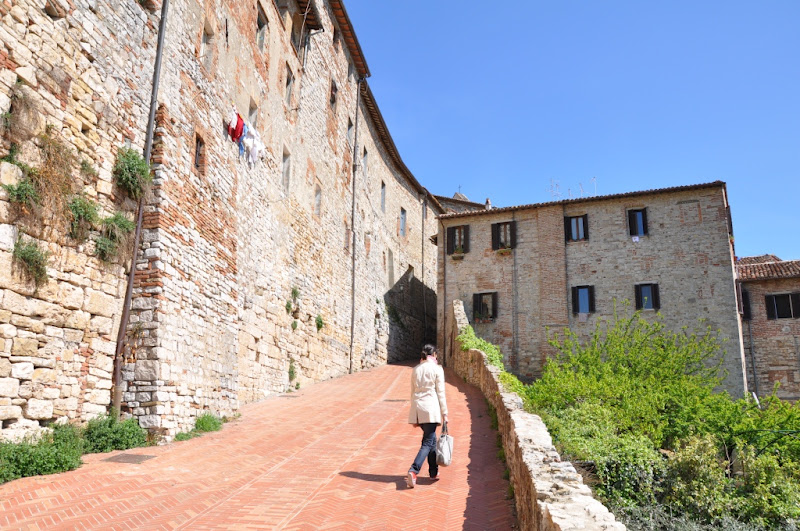
While walking around the area in the photo below, we happened upon the entrance to a subterranean area of the city that dates back to the Etruscan period. It was really interesting to see various caves and cisterns carved deep into the volcanic rock by people thousands of years ago -- particularly given the tools that they were limited to (even with the benefit of today's technology, I would have no clue how to replicate what they did). 


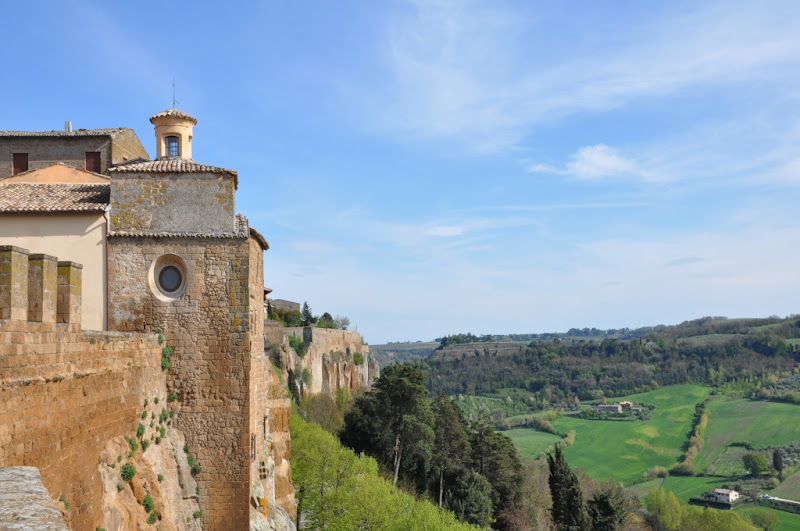
Our time in Orvieto went by fast, and before we had a chance to see all the sights it was time to head back to Rome in order to catch our flight. Here's a final shot that I took as we were looking along the edge of the city. You can see how the buildings / walls were built right into the volcanic rock.


I have to say that Orvieto was easily one of my favorite cities during our trip. I definitely would like to come back for a return visit to see some of what we missed -- notably the Albornaz Fortress (a 14th century fortification with the famous Pozzo di San Patrizio well) and the underground city (a labyrinth of tunnels, caves and other sights carved into the volcanic rock -- the spot we actually saw was apparently just a mini version).

Todi

.
We began our final day in Italy with a visit to a small hill-top town called Todi. According to an ancient legend (c. 1300 BC), the town was created by Hercules. 


While the weather was beautiful, it was definitely a bit cold out. In fact, the nearby mountains (visible in the background of the picture below) had gotten some snow the night before.


We began our visit in the city's Piazza del Popolo. The central plaza is surrounded by medieval-era buildings and was built over ancient Roman cisterns that remained in use until the early 20th century.


At one end of the plaza is the city's 11th century cathedral, which was supposedly built over an ancient Roman temple honoring Apollo.


Next we headed to the church of San Fortunato, known for its partially completed façade (the lower half was completed in the 15th century, while the top half was never finished).


The church has a tall belltower (partially visible in the photo above), which we climbed up for a better view of the city. It was interesting to see how densely structured the city's medieval center was, with only the main plaza really offering much open space.


The tower also offered a nice view of some of the older buildings on the edge of the historical center, such as the brick church below.


Todi is surrounded by three separate concentric city walls: one from the ancient Etruscan period, one from the ancient Roman period, and third from the medieval period. I never could tell which was which, but given the number of gates that we passed through I'm sure that we saw all of them at some point.


I think the following was part of the medieval wall, as it was on the periphery of the historic center.


We finished up our visit to Todi at the Santa Maria della Consolazione, a 16th century church just outside the city walls. We arrived at an inopportune time, however, as it was closed for an hour and we didn't have time to wait for it to open. Nevertheless, we had a nice view of the church from the outside so we didn't leave empty-handed.

Sunday, April 8, 2012

Arezzo

.
For the afternoon we headed to Arezzo, a town that fans of Roberto Benigni's Life is Beautiful will recognize. It is where the main characters lived during the first part of the movie.

The city's historic center is surrounded by a medieval wall, with a number of gates to pass through.


Our first stop was the city's Roman amphitheater, or what's left of it. While I'm a big fan any type of ancient Roman site, the visit was driven primarily by the fact that the adjacent museum offered shelter from what was left of the passing storm.


Next we visited the Piazza Grande, the city's central plaza and the site of its main marketplace during medieval times.


The city definitely had a medieval feel to it, with plenty of towers and buildings with castle-like architecture on most streets.


The following is Arezzo's cathedral, whose construction began in the 13th century.


I preferred the Santa Maria della Pieve church, which had a much more interesting look to it given its three loggias and massive tower. It was built over 1,000 years ago and seems to have held up pretty well over the course of a millenium.


The highlight of our visit to Arezzo was the Basilica of San Francesco, a 13th-century church dedicated to St. Francis of Assisi. While it may not look overly impressive from the outside, the interior includes the 15th-century frescos of the Legend of the True Cross.


Photos were prohibited, but I found one online that shows a few of the frescos. It doesn't fully capture the experience, but at least offers some perspective.


I subsequently learned that there was an underlying reason for our visit to Arezzo, and the basilica in particular -- The English Patient. One of Emilie's favorite scenes was filmed inside the church, where Julliette Binoche's character got a VIP tour of the frescos...


With Emilie's English Patient Pilgrimage finally complete, we headed back to our hotel outside Perugia. By this point the sun had come back out, which offered a nice late-afternoon view of the surrounding landscape.